Transform AI Context Management with Temporal Knowledge Graphs
As Large Language Models evolve from static chatbots to autonomous agents, maintaining long-term, evolving context becomes critical. Temporal Knowledge Graphs enable AI systems to understand not just what is true, but when it was true and why understanding has changed.
Performance Impact
Accuracy Improvement (LongMemEval)
+17.5%
From 82.5% to 100%
Response Latency Reduction
-90%
From 1000ms to 100ms
Hallucination Reduction
-66.7%
From 12.3% to 4.1%
Accuracy Improvement (DMR)
+1.4%
From 93.4% to 94.8%
Detailed Analysis
Accuracy Metrics Across Benchmarks
- Traditional RAG
- Temporal KG
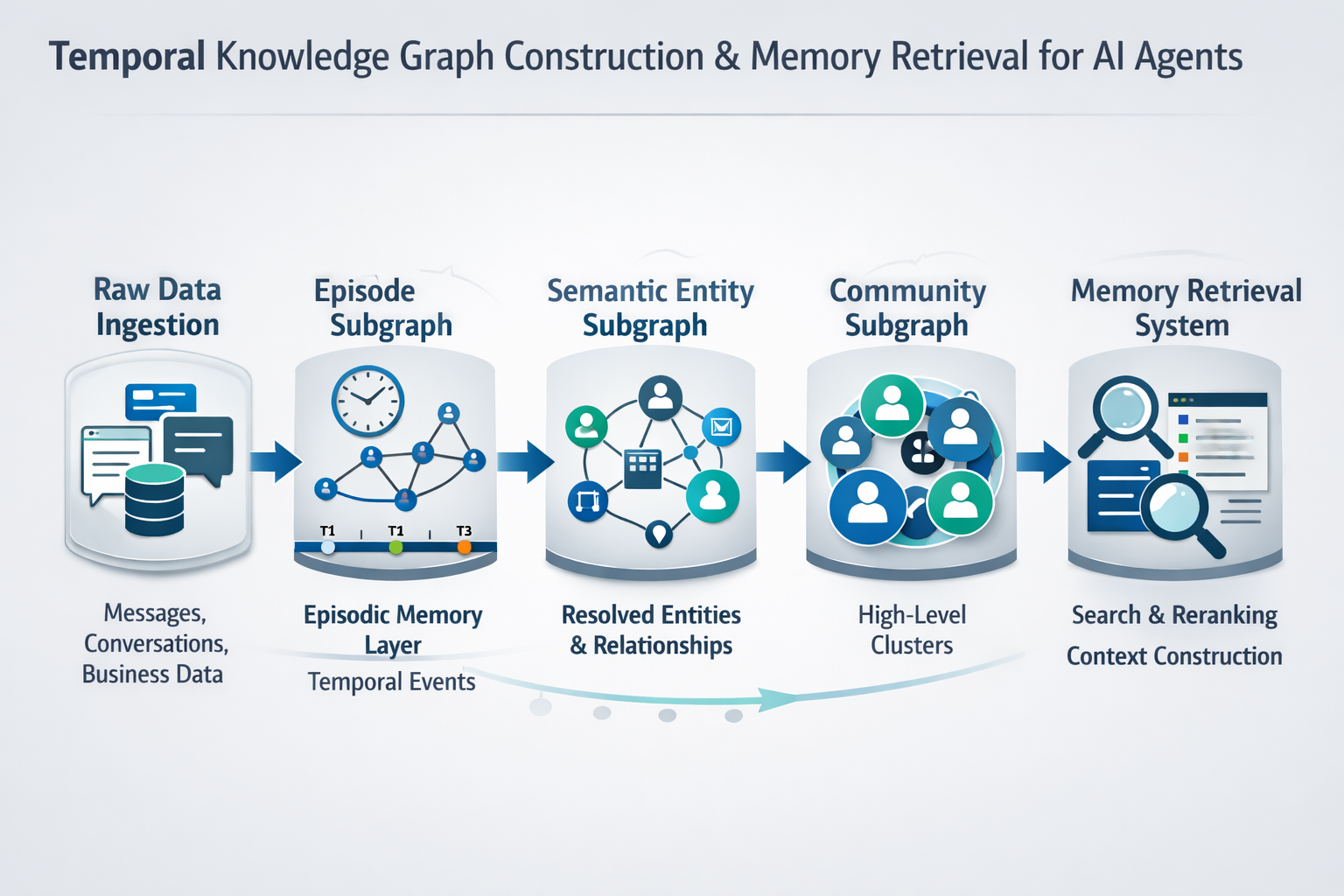
System Architecture
Three-Tier Hierarchical Design
Episode Subgraph
Raw data storage with temporal markers. Preserves original context and sequence of information.
Semantic Entity Subgraph
Resolved entities and relationships extracted from episodes. Enables semantic reasoning.
Community Subgraph
High-level clusters of related entities. Provides global context and efficient retrieval.
Memory Retrieval Process
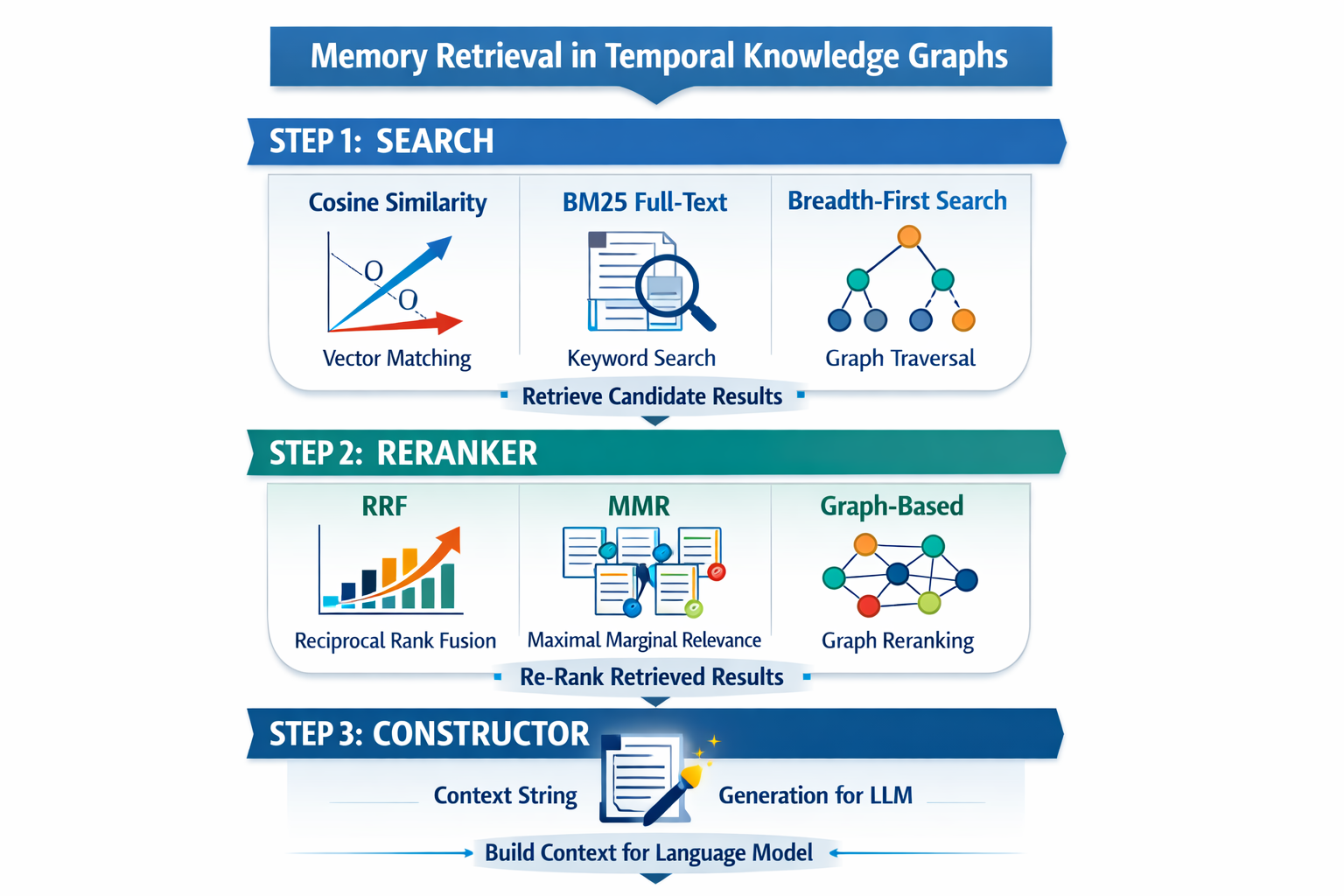
Step 1: Search
Multiple search methods identify candidate nodes and edges:
- • Cosine semantic similarity
- • BM25 full-text search
- • Breadth-first graph traversal
Step 2: Reranker
Sophisticated ranking prioritizes relevant results:
- • Reciprocal Rank Fusion
- • Maximal Marginal Relevance
- • Graph-based reranking
Step 3: Constructor
Transforms results into LLM-ready context:
- • Temporal annotations
- • Entity summaries
- • Confidence indicators
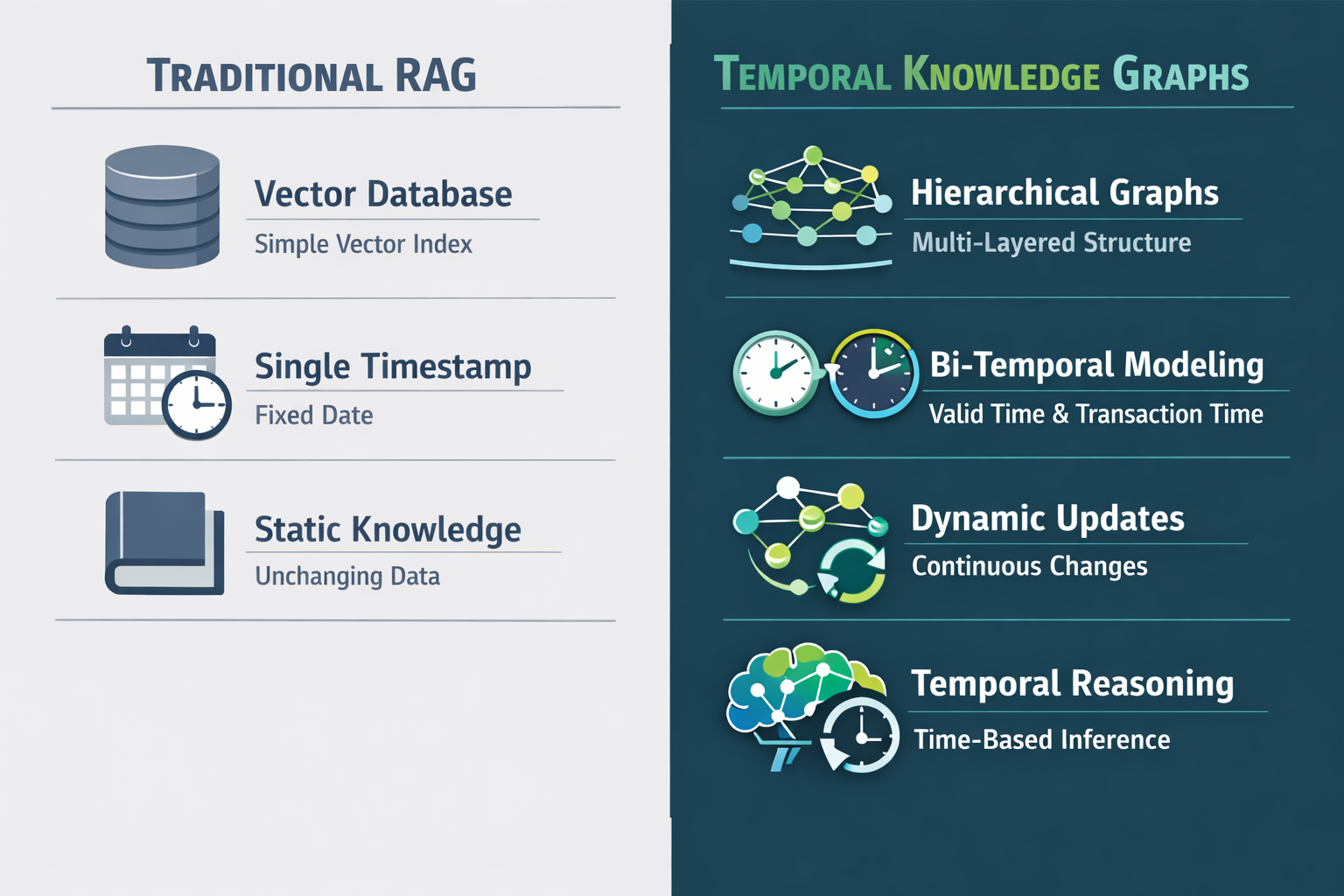
Traditional RAG vs Temporal Knowledge Graphs
Key Takeaways
Temporal Reasoning is Critical
The larger accuracy improvement on complex, long-context tasks (17.5%) versus simple tasks (1.4%) demonstrates that temporal reasoning becomes increasingly important as task complexity increases.
Efficiency Enables Real-Time Applications
The 90% latency reduction enables real-time agent interactions that were previously infeasible with traditional RAG approaches requiring full corpus search.
Hallucination Reduction Through Grounding
By maintaining a structured, temporally consistent factual base, temporal knowledge graphs significantly reduce the model's tendency to invent details that contradict historical records.
Enterprise-Ready Architecture
The hierarchical design and bi-temporal modeling make temporal knowledge graphs suitable for complex enterprise scenarios involving multiple stakeholders and evolving contexts.
Ready to Transform Your AI Systems?
Temporal Knowledge Graphs represent the future of AI context management. Download the complete white paper to learn how to implement these systems in your organization.
References
- [1] Rasmussen, P., et al. (2025). Zep: A Temporal Knowledge Graph Architecture for Agent Memory. Zep AI.
- [2] Lewis, P., et al. (2020). End-to-End Open-Domain Question Answering with Retriever-Reader Architectures. arXiv.
- [3] Cai, L., et al. (2024). A Survey on Temporal Knowledge Graph: Representation, Acquisition, and Applications. arXiv.
- [4] Knez, T., & Žitnik, S. (2023). Event-centric temporal knowledge graph construction: A survey. Mathematics.
- [5] Luo, D., et al. (2025). Leveraging Temporal Knowledge Graphs and LLMs for Multi-Agent Systems. FIU Research.